
Content in context: The missing element in your client communications

Content in context: The missing element in your client communications
Generic messaging doesn’t work in B2B communication. Why? Because it lacks context. Studies show that 60–70% of B2B content goes unused because it doesn’t align with client needs. This leads to lost engagement, eroded trust, and wasted effort. The solution? Personalized, context-driven communication.
Here’s how you can improve your client communication:
- Understand the client’s journey: Tailor messaging based on where they are in the sales cycle.
- Use tools like Journey.io: Combine content delivery, real-time analytics, and AI for smarter, personalized messaging.
- Leverage data: Behavioral, geographic, and historical insights help craft relevant content.
- Track and refine: Use KPIs like engagement rates and revenue impact to measure success and improve.
Personalized, context-aware communication drives stronger relationships, faster sales cycles, and better results.
Understanding Client Context
Key Elements of B2B Client Context
Clear client context is essential for effective B2B communication. Here are the main components:
- Customer Journey: Understand where clients are by evaluating their engagement, past interactions, and current challenges.
- Audience Segmentation: Recognize that each client’s journey is unique, allowing for personalized messaging tailored to specific groups.
- Consistent Messaging: Maintain clear and unified communication across all platforms.
These elements directly impact measurable results. As Forrester notes:
"Successful customer journey maps go beyond just touchpoints - they address emotions, needs, and expectations across different phases of the customer lifecycle."
Context's Effect on Results
Research highlights the benefits of optimizing customer journeys:
| Performance Metric | Improvement |
|---|---|
| Customer Satisfaction | Up to 15% increase |
| Revenue Growth | 20–40% increase |
| Cost Reduction | 10–20% decrease |
These numbers show how relevant, timely messaging can boost engagement and drive business growth. By aligning communication with each client’s specific needs, businesses can build stronger relationships and improve teamwork. As Gartner points out:
"Cross-functional collaboration is crucial to delivering consistent and cohesive experiences, particularly in complex B2B environments."
Methods for Context-Based Content
AI-Powered Personalization Tools
AI is changing the game when it comes to tailoring communication. According to research, 77% of marketers using generative AI report better personalization in their campaigns. Journey.io is a great example of this shift. Its AI tools analyze how clients interact with content and adjust delivery strategies automatically. Key features include:
- Creating industry-specific content on the fly
- Adjusting messaging tone to fit audience preferences
- Designing personalized landing pages for different audience segments
Success Stories and Examples
These tools aren't just theoretical - they deliver real results. Here are a couple of standout examples:
- Nickelodeon: In April 2015, they used weather-targeting technology to customize email campaigns. Subscribers in snowy areas received "snow day" messaging, which led to a 75% jump in click-through rates immediately and nearly quadrupled by the end of the day.
- Notion: Their approach to contextual content paid off with:
- 49–51% email open rates through personalized onboarding
- A 6–7% boost in conversions from localized campaigns
- A 20% increase in open rates via strategic A/B testing
Using Data to Guide Content
Data is the backbone of effective, context-aware content. For instance, 82% of consumers are more likely to open emails with personalized subject lines. Here's how different types of data can be applied:
| Data Type | Application | Impact |
|---|---|---|
| Behavioral | Tracks engagement patterns | Helps refine timing and format |
| Geographic | Customizes content by location | Adds regional relevance |
| Historical | Analyzes past interactions | Improves future targeting |
| Real-time | Adapts content dynamically | Boosts immediate engagement |
By combining these data types, while respecting privacy standards, you can craft content that feels directly relevant and tailored to your audience.
"The personalization that you can leverage with AI allows the consumer or the subscriber to feel like you're talking to them one-on-one versus one-to-many." – Lauren Petrullo, CEO and founder of Mongoose Media
These strategies highlight how data-driven, context-based communication can transform engagement across various channels.
Implementing Context-Based Communication
Content Management with Journey.io
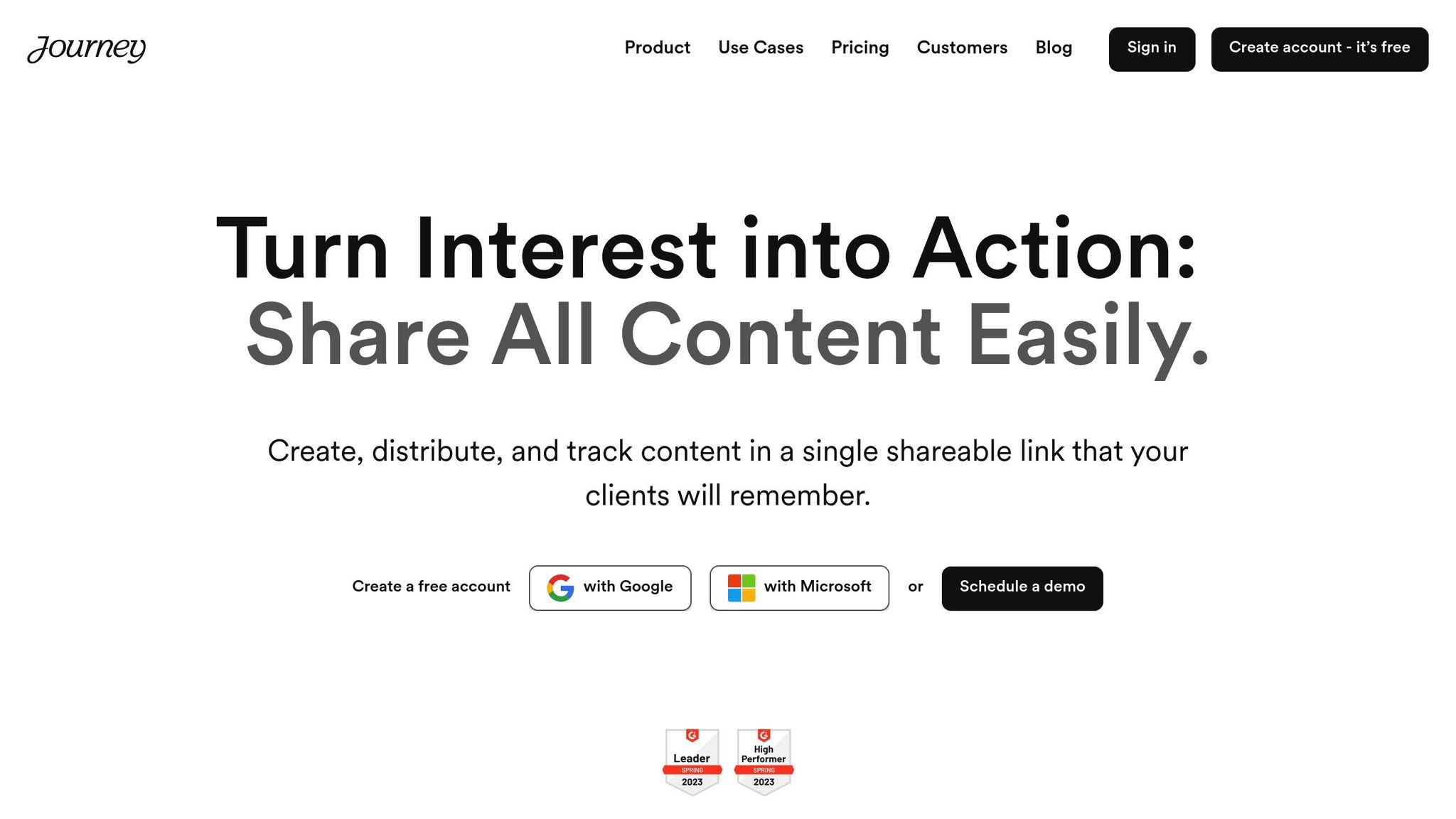
Journey.io simplifies the process of creating and sharing content tailored to specific contexts. It allows teams to bundle different types of content into a single, shareable experience. Here’s how it helps:
- Multi-format Integration: Combine PDFs, videos, text, and AI-generated visuals into one link
- Real-time Analytics: Monitor how prospects engage with your content and their behavior
- Customizable Content Blocks: Use AI to create dynamic text, interactive buttons, and embed resources
This system ensures that important content doesn’t get lost or scattered. While streamlined content management is crucial, aligning messaging across channels is just as important.
Multi-Channel Message Alignment
Keeping messages consistent across different channels ensures you make the most of a unified content system. Journey.io supports this with its robust content distribution features. Here’s how it works:
| Channel | Feature | Benefit |
|---|---|---|
| Sales Communications | Shareable Journey Links | A single source of truth for interactions |
| Client Success | Real-time Activity Tracking | Deliver timely and relevant support |
| Marketing Content | Dynamic Content Blocks | Maintain brand consistency everywhere |
| Stakeholder Updates | Secure Sharing Options | Control access with custom permissions |
Building Response-Driven Content
To go a step further, response-driven strategies can make client interactions even more personalized. Journey.io enables this with tools like interactive comment sections, integrated chatbots, and adaptive content. It also includes features that optimize performance, such as behavioral tracking, AI-assisted content creation, and interactive elements designed to improve engagement.
sbb-itb-e400484
Tracking and Improving Results
Performance Metrics That Matter
Measuring the success of personalized communication requires focusing on key performance indicators (KPIs). With Journey.io's analytics dashboard, you can track metrics that show how well your tailored content is working.
Here are some key metrics to focus on:
| Metric Category | What to Track | Why It Matters |
|---|---|---|
| Engagement | Click-Through Rate (CTR), Time on Content | Shows how effectively your content connects with your audience. |
| Revenue Impact | Average Revenue Per User (ARPU), Customer Lifetime Value (CLV) | Highlights the financial results of personalized messaging. |
| Content Effectiveness | Conversion Rate, Cart Abandonment | Measures how well your content drives desired actions like purchases. |
| Resource Efficiency | Human Resource Time, Tool Usage | Helps identify areas to reduce costs and improve the efficiency of your efforts. |
For example, Bear Mattress increased its revenue by 16% by using VWO's analytics to track personalized recommendations. These metrics provide a solid foundation for testing and refining your content strategy.
Testing and Refinement Process
Once you've identified key metrics, continuous testing is the next step to fine-tune your personalized content strategy. Regular testing and adjustments ensure your content stays effective.
"Each metric uniquely impacts personalization success. Thus, it's important to know when to track a particular metric depending on the goal" – Ketan Pande from VWO.
Here are some proven testing strategies:
-
Segment-Based Testing
Build with Ferguson saw an 89% increase in purchases by targeting specific consumer segments with personalized recommendations. -
Iterative Optimization
Synchrony improved application submissions by 4.5% by simplifying call-to-action buttons for high-intent users. -
Real-Time Adjustments
Starbucks ran a campaign with 400,000 personalized messages, leading to a threefold increase in offer redemptions.
Journey.io's testing tools make it easier to:
- Analyze performance across audience segments.
- Test multiple content versions at the same time.
- Use data insights to make real-time improvements.
- Measure how changes impact your key metrics.
How to master personalization in B2B marketing
Conclusion: Using Context to Strengthen B2B Communication
Context-focused communication plays a key role in building successful B2B relationships. Sharing the right content at the right time helps create meaningful connections that can drive business growth. This is especially important as more B2B buyers - about 75% - now prefer digital engagement over traditional, in-person methods.
To address these shifts, Journey.io offers a platform designed to streamline client communication. It combines real-time analytics and AI-driven personalization to ensure your messaging aligns with client needs at every stage of their journey.
Here’s how you can organize your communications effectively:
- Equip decision-makers with resources they can easily share
- Track engagement with instant insights into prospect activity
- Simplify content updates to keep your messaging relevant
- Support every stage, from prospecting to long-term retention
The future of client communication is all about delivering personalized, context-aware experiences. With tools like Journey.io, you can transform disjointed communication into cohesive, impactful interactions that help build strong, lasting business relationships.
Related Posts