
How AI Improves Customer Success Strategies

How AI Improves Customer Success Strategies
AI is transforming customer success by automating repetitive tasks, predicting customer needs, and personalizing interactions. Here’s what you need to know:
- Automation: AI handles tasks like ticket routing, data entry, and follow-ups, saving teams over 10 hours per week.
- Personalization: By analyzing customer behavior, AI delivers tailored recommendations and real-time content.
- Predictive Analytics: AI identifies churn risks and growth opportunities, helping teams act before problems escalate.
- Sentiment Analysis: AI detects emotional tones in customer interactions, ensuring timely and empathetic responses.
Businesses using AI report a 10–15% drop in churn and faster issue resolution. Whether you’re a small team or part of a large organization, integrating AI into your customer success strategy can enhance efficiency and improve outcomes.
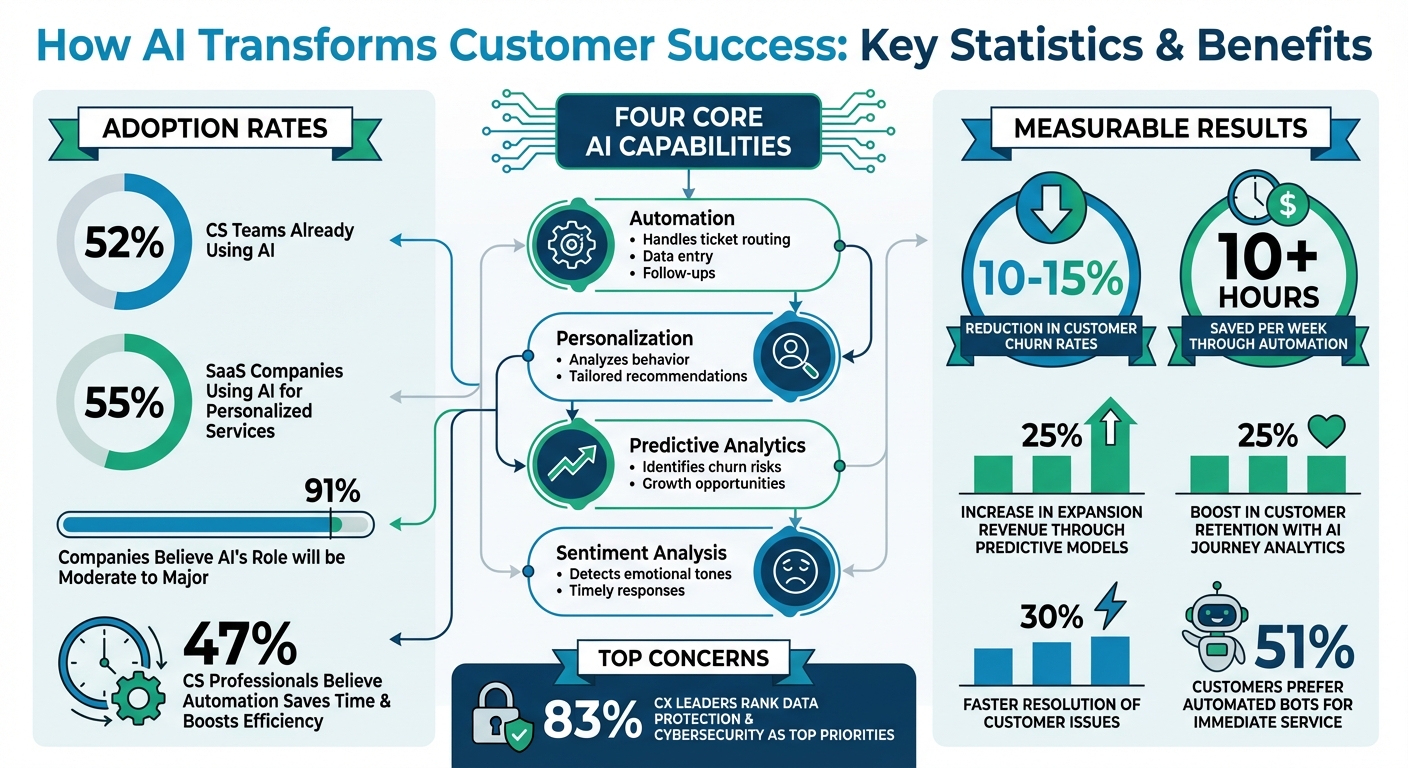
AI Impact on Customer Success: Key Statistics and Benefits
Master AI in Customer Success: The 5 Pillars You Need Now
sbb-itb-e400484
Using AI to Personalize Customer Engagement
Personalization has shifted from being a bonus to a customer expectation. While AI is already known for reducing churn and automating workflows, its ability to drive personalized engagement is what fosters meaningful customer interactions. By analyzing massive amounts of data, AI identifies each customer's preferences and delivers experiences tailored just for them.
And the stats prove it: 55% of SaaS companies are leveraging AI to offer more personalized services. Here's how AI dives into behavioral data to make this happen.
AI-Powered Behavioral Analysis
AI has a knack for spotting patterns that humans might miss. It sifts through product usage data, support tickets, email conversations, and interaction histories to paint a detailed picture of each customer's needs.
Sentiment analysis kicks this up a notch by gauging the emotional tone of customer interactions. Whether it's an email, a phone call, or a feedback form, AI can detect emotions like frustration, satisfaction, or confusion. This allows your team to respond with the right mix of empathy and urgency.
Denise Stankowski, VP of Product Management at Gainsight, captures this well: "The huge opportunity Generative AI offers us is just giving us sanity out of that crazy noise of inputs. Not to tax our brains unnecessarily but to synthesize them".
AI doesn’t stop at understanding emotions. It powers recommendation engines that guide the next best action for each customer. For example, it might suggest a product feature they’ve yet to explore, direct them to a helpful article, or recommend an educational resource based on their activity. These suggestions aren’t random - they’re based on what’s worked for similar customers in similar scenarios.
Real-Time Content Personalization
Static, one-size-fits-all content no longer cuts it. Customers now expect information that adapts to their unique circumstances and arrives exactly when they need it. AI steps in here, delivering real-time content that truly connects.
Through predictive models, AI enables send-time optimization, pinpointing the exact moment each customer is most likely to engage with an email or notification. This ensures your message reaches them when they’re most attentive.
Platforms like Journey.io take things even further. Teams can share dynamic content - like PDFs, videos, or interactive tools - via links that adapt based on who views them. These tools track engagement in real time, showing which materials resonate and which don’t. This feedback loop, powered by behavioral insights and sentiment analysis, allows you to refine your content strategy based on real actions rather than guesswork.
Of course, none of this works without clean, high-quality data. AI thrives on accurate and comprehensive information to deliver its best results.
Predictive Analytics for Customer Success
Personalization enhances what's happening now, but predictive analytics equips teams to tackle what's coming next. Instead of reacting to problems as they arise, AI dives into usage patterns, support interactions, and customer sentiment to anticipate issues before they snowball. This approach helps teams allocate resources strategically, building on personalized engagement to create a more proactive and efficient customer success strategy.
It’s no surprise that 52% of customer success teams are already incorporating AI into their processes. Nick Mehta, CEO of Gainsight, sums it up perfectly:
"What's predictive of churn? How do you drive a better upsell or advocacy in your client base to help you do a better job with your customers? ... AI is going to radically make customers and customer success better."
Predicting Churn Risk
AI excels at spotting churn risks by processing massive datasets that include usage trends, customer support history, and engagement records. Early warning signs - like a drop in logins or reduced feature usage - don’t go unnoticed.
Customer Health Scores are a key tool in this process. These scores consolidate data into a real-time snapshot of account stability. AI-powered scorecards analyze historical trends to suggest adjustments, and when a score dips below a set threshold, the system can trigger retention campaigns or notify account managers.
This automation doesn’t just identify risks - it saves time. Customer success teams reclaim over 10 hours per week by letting AI handle churn detection tasks. Additionally, intelligent alerts keep tabs on external factors like mergers, acquisitions, or leadership changes, enabling teams to respond quickly to external shifts that might affect customer relationships.
Finding Expansion Opportunities
Predictive analytics isn’t just about avoiding losses; it’s also a powerful tool for spotting growth opportunities. AI scans usage data for signs that a customer is ready for an upsell or cross-sell. For instance, frequent feature-limit hits or rapid adoption of specific tools can signal expansion potential. Predictive models have been shown to increase expansion revenue by up to 25%.
Expansion Opportunity Scoring Models analyze factors like growth in usage and the speed of feature adoption to identify accounts primed for upgrades or additional services. AI can flag customers exploring premium features or consistently maxing out their current plans, making it easier for teams to identify opportunities for expansion conversations. Other signals - like a growing user base or the involvement of new decision-makers - further indicate readiness for upgrades.
Automating Customer Success Workflows with AI
AI is transforming customer success by taking over repetitive tasks like data entry, ticket triage, meeting scheduling, and follow-up emails. By automating these processes, teams can shift their focus to building stronger relationships and working on strategic goals. It's no wonder that 47% of customer success professionals believe automation helps save time and boosts efficiency.
Tom Eggemeier, CEO of Zendesk, sums up the power of AI in this space:
"Only AI trained on billions of customer interactions knows in an instant how best to serve them."
AI also enhances self-service options. Tools like digital agents and dynamic knowledge bases address common questions and resolve basic issues 24/7. This reduces the load on human agents, and it aligns with consumer preferences - 51% of customers say they prefer automated bots for immediate service rather than waiting for a person. These automated systems are a key part of a broader AI strategy designed to anticipate and fulfill customer needs efficiently.
Automated Playbooks and Workflows
AI doesn’t just automate tasks - it orchestrates entire workflows based on real-time customer behavior. For instance, if a customer's engagement drops or their usage patterns change, AI can automatically activate targeted playbooks. Imagine a customer showing early signs of disengagement receiving a personalized onboarding refresh without any manual intervention. These playbooks adapt instantly based on how customers interact with the product.
Denise Stankowski, VP of Product Management at Gainsight, explains the advantage:
"The huge opportunity Generative AI offers us is just giving us sanity out of that crazy noise of inputs. Not to tax our brains unnecessarily but to synthesize them."
AI-Driven Sentiment Analysis
AI takes automation a step further with sentiment analysis, adding an emotional layer to customer interactions. By analyzing emails, calls, and tickets, AI can detect shifts in customer sentiment in real time. For example, if a customer's tone changes from positive to negative, the system can escalate the case to a senior team member or trigger a retention playbook to address the situation proactively.
This technology also helps teams prioritize effectively. Instead of handling tickets in the order they arrive, AI identifies which customers are upset or at risk and ensures those cases are routed to the best-equipped agents. During live interactions, AI tools provide agents with sentiment insights and account history, enabling them to respond with empathy and precision. These capabilities enhance proactive outreach and strengthen the overall customer success strategy.
The impact is clear. Companies using AI for sentiment analysis and automation have reported a 10% to 15% reduction in customer churn rates. Harry Wray, Director of CX at Zendesk, underscores the importance of aligning AI efforts with broader business goals:
"Generally speaking, companies should establish goals aligned to variations of three or four broader objectives. These are: Improve revenue; reduce costs; improve customer experience; [and] improve employee experience."
Real-Time Customer Journey Mapping and Reporting
AI has already made waves in personalization, predictive analytics, and workflow automation. Now, it’s reshaping customer journey mapping by offering a real-time, dynamic look at how customers interact with businesses. Traditional journey maps, while useful, often become outdated quickly. AI changes the game by creating models that update in real time, tracking customer behavior across multiple channels.
This shift is crucial because customer journeys today are anything but linear. People bounce between channels, pause their research, and return weeks later - often through entirely different touchpoints. AI connects these fragmented interactions into a single, cohesive view, showing how customers actually behave, not how you think they should. This unified perspective allows businesses to act immediately when needed.
As Nextiva puts it:
"Customer journey mapping is no longer about visualizing paths. It's about predicting needs, eliminating friction, and responding in real time. AI makes this proactive model achievable."
The results speak for themselves. Companies using AI for journey analytics have reported up to a 25% boost in customer retention and 30% faster resolution of customer issues. By spotting friction points - like abandoned onboarding processes or declining engagement with specific features - AI helps businesses intervene early, reducing churn.
Dynamic Journey Mapping
AI takes journey mapping to the next level by continuously tracking interactions and updating each customer’s journey in real time. This allows businesses to trigger automated responses the moment significant changes occur.
For instance, if many users disengage with a feature shortly after trying it, AI can flag this trend. It can then prompt a targeted action, like sending a tutorial or having the customer success team check in with those users. These timely interventions can make all the difference.
Data-Driven Reporting and Insights
Beyond mapping, AI excels at turning raw data into meaningful insights. It can process unstructured information - like meeting transcripts, call recordings, or emails - and automatically generate reports that highlight what truly matters. This eliminates the need for teams to manually sift through countless interactions to spot trends.
The focus of these reports is on metrics that drive results, such as Net Promoter Score (NPS), Customer Satisfaction (CSAT), churn rates, and time to first value. AI constantly monitors these KPIs, flagging any significant changes. For example, it might detect a sharp drop in the health score of a high-value account or identify patterns suggesting a customer is ready for an upsell opportunity.
Platforms like Journey.io take this a step further by allowing customer success teams to package AI-generated reports, usage analytics, and tailored recommendations into interactive content experiences. Instead of relying on static PDFs that often get buried in inboxes, these platforms create shareable links with real-time tracking. This way, businesses can see which sections resonate most with clients.
When AI identifies a customer at risk, it doesn’t stop at alerting the team. It updates their journey map, adjusts their health score, and activates the appropriate playbook. Whether it’s a personalized email, a product tutorial, or a follow-up alert, AI ensures the right action happens at the right time.
Adding AI to Your Customer Success Stack
Once you've seen how AI can personalize engagement and streamline workflows, the next step is figuring out how to weave these capabilities into your customer success stack. The good news? You don’t need to start from scratch or overhaul your entire system. Instead, focus on upgrading your current tools with AI to address specific challenges. Already, more than 50% of customer success teams are using AI in some capacity, and 91% of companies believe it will play a moderate to major role in shaping their strategy. The key is to set clear goals before diving in.
Identifying Business Needs and Pain Points
Start by pinpointing the challenges your team faces.
Harry Wray, Director of CX at Zendesk, explains: "Generally speaking, companies should establish goals aligned to variations of three or four broader objectives. These are: Improve revenue; reduce costs; improve customer experience; [and] improve employee experience".
Struggling with a flood of support tickets? Losing customers early in their journey? Spending too much time on manual data entry? Each pain point likely calls for a tailored AI solution.
Your customer journey map can be a great tool for identifying friction points. For example, if onboarding takes too long, consider AI-driven guidance to speed things up. If churn signals are slipping through the cracks, predictive analytics might be the fix. Let these challenges guide your AI investments. Also, check whether your current tools already include AI features before committing to standalone solutions.
Integrating with CRM Tools
AI becomes even more powerful when seamlessly combined with your existing systems. Tools like Salesforce or HubSpot, for instance, can integrate AI to enhance workflows without disrupting familiar processes. This ensures that AI models are fed with high-quality data, helping your team work smarter.
Denise Stankowski, VP of Product Management at Gainsight, highlights: "The huge opportunity Generative AI offers us is just giving us sanity out of that crazy noise of inputs. Not to tax our brains unnecessarily but to synthesize them".
When connecting AI to your CRM, prioritize security and data privacy. According to research, 83% of CX leaders rank data protection and cybersecurity as top concerns when adopting AI. Start small with pilot projects to showcase value before scaling up. Platforms like Journey.io can integrate directly into your tech stack, delivering AI-powered insights, usage analytics, and tailored recommendations. These tools even let you track which parts of your content resonate most with customers.
Measuring ROI and Success Metrics
To gauge the impact of AI, track both quick wins and long-term results. For instance, AI automation can save customer success teams over 10 hours per week by handling repetitive tasks like data entry and churn detection. AI adoption has also led to a 10% to 15% drop in customer churn rates for some companies. Beyond efficiency, these tools drive measurable improvements in critical outcomes.
Here are some key performance indicators to consider:
| KPI Category | Metrics to Track | What AI Improves |
|---|---|---|
| Financial | Churn Rate, Net Revenue Retention (NRR) | Spotting at-risk accounts and uncovering growth opportunities |
| Customer Experience | CSAT, NPS, Sentiment Score | Customizing interactions and analyzing emotional tone |
| Operational Efficiency | Cost to Serve, Response Times, Hours Saved | Automating repetitive tasks and speeding up responses |
| Onboarding | Time to First Value, Implementation Time | Streamlining customer guidance with AI-driven resources |
Nick Mehta, CEO of Gainsight, emphasizes: "No matter who you are, we know that AI can make your job easier and better. On top of that, you can make better decisions with better insights about your client".
The ultimate goal isn’t just faster workflows - it’s about making smarter choices that keep your customers engaged and drive growth for your business.
Conclusion
AI has shifted from being a novelty to becoming a critical component of customer success strategies. What was once optional is now a key factor for businesses aiming to remain competitive and nurture customer loyalty.
The foundation of AI-powered customer success lies in three core elements: personalization, automation, and predictive analytics. Together, these transform the way teams operate. Personalization enables businesses to deliver tailored experiences at scale. Automation takes over repetitive tasks like data entry and ticket routing, allowing teams to focus on higher-value work. Predictive analytics changes the game entirely by moving from reactive problem-solving to proactive engagement - spotting churn risks and growth opportunities long before they emerge. These benefits aren’t just theoretical; they drive measurable results.
For example, companies leveraging AI report 10% to 15% reductions in customer churn rates, while customer success teams save over 10 hours per week by automating manual tasks. These efficiencies don’t just streamline operations - they directly impact profitability.
Platforms like Journey.io bring these capabilities to life by embedding AI-driven insights into customer success workflows. With features like real-time engagement tracking and personalized content delivery, tools like this ensure teams have the information they need to make faster, smarter decisions. When paired with clear objectives and reliable data, AI evolves from being just another tool to becoming a true competitive edge.
FAQs
How can AI help identify customer churn risks and growth opportunities?
AI enables businesses to anticipate customer churn and spot new growth opportunities by analyzing vast amounts of customer data. It detects patterns - like reduced engagement or shifts in behavior - that may indicate a customer is at risk of leaving. This gives teams the chance to act quickly and implement strategies to keep customers on board.
On the flip side, AI also highlights trends and preferences that could lead to upselling or business expansion. By providing actionable insights, it helps companies craft personalized approaches that deepen customer relationships and promote sustained success.
How does AI-driven sentiment analysis enhance customer success?
AI-powered sentiment analysis gives businesses a way to tap into customer emotions and attitudes by examining language, tone, and behavior in real time. This means companies can spot feelings like satisfaction, frustration, or excitement, allowing them to address concerns quickly and tailor their responses for better engagement and stronger connections.
When negative sentiment is detected early, businesses can step in to resolve issues before they escalate, reducing the risk of losing customers and improving satisfaction levels. This approach also delivers useful insights into the customer experience, helping fine-tune communication and service strategies. By weaving sentiment analysis into their customer success efforts, companies can create more empathetic and meaningful interactions, ultimately driving loyalty and retention.
How can businesses use AI to enhance their customer success strategies?
Businesses today can leverage AI to transform their customer success strategies. By automating repetitive tasks, offering tailored recommendations, and analyzing customer behavior more deeply, AI tools allow teams to address customer needs more effectively. This not only boosts engagement but also simplifies workflows, ultimately improving customer retention and satisfaction.
To make the most of AI, companies should begin with small pilot projects, ensuring these tools align with their broader goals. Human oversight is key to keeping the approach customer-centric. AI can also uncover growth opportunities, anticipate challenges, and deliver real-time analytics, giving teams the insights they need to make smarter decisions. When implemented thoughtfully and paired with strong collaboration between AI systems and human teams, the impact on customer success can be transformative.
Related Posts