
Interactive Onboarding with AI: Use Cases
Interactive Onboarding with AI: Use Cases
AI is transforming onboarding by making it faster, more personalized, and more effective. Here’s what you need to know:
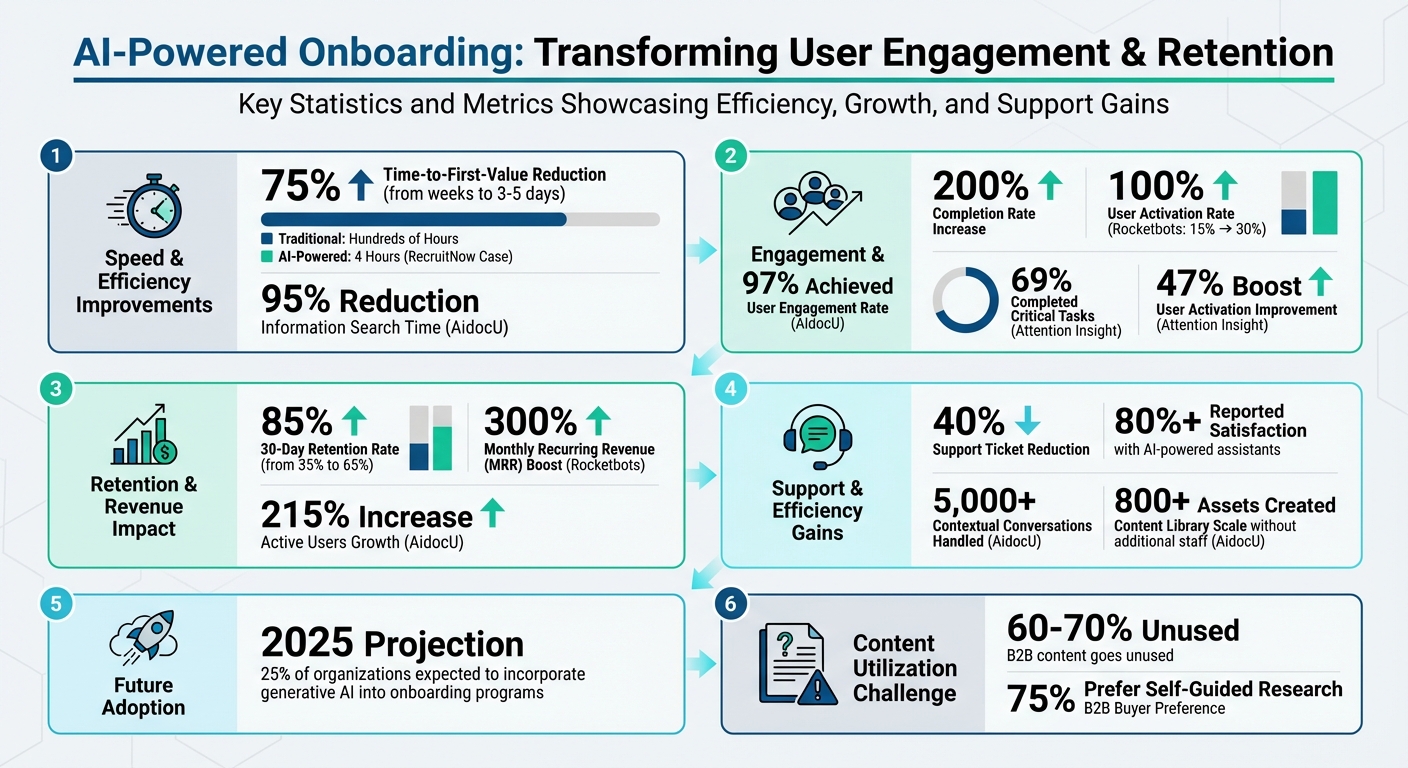
- Faster Results: AI reduces Time-to-First-Value by up to 75%, cutting onboarding timelines from weeks to just days.
- Higher Engagement: Completion rates improve by 200%, and 30-day retention rates increase by 85%.
- Personalized Experiences: AI tailors onboarding to individual roles, industries, and real-time user behavior.
- Proactive Support: Predictive analytics flag at-risk users, triggering timely interventions to prevent drop-offs.
- Automation: AI chatbots handle repetitive tasks, provide guidance, and escalate complex issues to human agents.
Key Examples:
- Rocketbots: Boosted activation rates by 100% and tripled Monthly Recurring Revenue with AI-driven walkthroughs.
- AidocU: Achieved 97% engagement and cut search times for critical info by 95% with role-specific training.
- RecruitNow: Reduced training hours from hundreds per month to just four using AI chatbots.
AI onboarding isn’t just about simplifying processes - it’s about delivering faster, smarter, and more user-focused experiences.
AI-Powered Onboarding Impact: Key Performance Metrics and ROI Statistics
AI Chatbots for User Guidance
Real-Time Assistance and Task Automation
AI chatbots are transforming how businesses handle onboarding and user support. They take over repetitive tasks, send timely reminders, and provide instant answers - all without needing a human touch.
What sets modern chatbots apart is their ability to offer context-aware interaction. Instead of serving up generic help articles, these chatbots analyze a user's role, current activity, and recent actions to deliver tailored guidance. As ShyftLabs aptly puts it: "Users want precision, not pages".
By embedding chatbots directly into apps, users can access walkthroughs and support right where they need it - no more switching tabs or hunting through scattered documentation. Thanks to Natural Language Processing, users can ask questions in plain language, like, "How do I export this?" The chatbot responds with a mix of text, screenshots, diagrams, or even videos, providing clear and actionable answers.
But these bots do more than just answer questions. They can set up user accounts, initiate specific setup actions, and even offer real-time voice guidance, walking users through complex features while controlling browser actions. When a problem requires escalation, chatbots seamlessly hand over a detailed interaction summary to human agents, ensuring the issue is resolved faster with full context.
These capabilities don’t just sound impressive - they deliver measurable results, as the following examples show.
Example: Chatbot-Driven Success
Take Rocketbots, a messaging platform that introduced AI-driven interactive walkthroughs to guide users during onboarding. The impact? Their activation rate jumped from 15% to 30%, and they saw a 300% boost in Monthly Recurring Revenue (MRR).
Similarly, RecruitNow leveraged AI chatbots to automate onboarding, slashing the time spent on face-to-face training. What once required hundreds of hours per month was reduced to just four hours. The chatbots handled routine questions, setup instructions, and task automation, allowing the team to focus on more strategic priorities.
The feedback speaks volumes - over 80% of users reported satisfaction with AI-powered assistants that provide role-specific, in-product guidance.
Personalized Onboarding Journeys
Role-Specific and Adaptive Learning
AI-powered onboarding takes personalization to the next level by analyzing how users interact with the platform and their specific context. It dives into behavioral data like click patterns, navigation habits, and feature usage, while also considering contextual factors such as industry, job role, and team size. This approach creates onboarding experiences that feel tailor-made for each user .
The system doesn't just stop at personalization - it adapts dynamically. For instance, it adjusts the pace based on how well users perform. Struggling with the basics? The platform slows down to provide extra guidance. On the flip side, advanced users are introduced to more complex features through a gradual process called progressive disclosure, ensuring they aren't overwhelmed .
Welcome surveys are another key element. These surveys collect user preferences upfront, triggering a journey that aligns with their needs and expectations . The results speak volumes: companies using AI-driven onboarding have reported up to a 200% jump in completion rates and an 85% boost in 30-day user retention.
To see how this works in practice, let’s look at a real-world example.
Case Study: Customized Onboarding in Action
In August 2024, Aidoc, a healthcare AI provider, rolled out an AI-powered enablement platform called AidocU to onboard its global sales and customer success teams. This platform used interactive Learning Pathways and an AI Agent to deliver training tailored for specific roles, including Sales Development Representatives (SDRs), Account Executives (AEs), and Customer Success Managers (CSMs).
Over the next 12 months, ending in January 2026, the results were striking. AidocU achieved a 97% user engagement rate and drove a 215% increase in active users. The AI Agent handled over 5,000 contextual conversations, enabling the enablement team to scale their content library to over 800 assets - without adding new staff. Even more impressively, sellers reported a 95% reduction in the time it took to find critical information.
"Letter AI - branded internally as AidocU - has helped transform how that knowledge is created, accessed, and shared across the organization. From structured learning paths to tools like the AI Agent and dynamic knowledge hubs, it's made it easier for teams to stay aligned, ramp faster, and focus on what really matters: driving value for our customers."
- Shuli E., VP of Customer Success, Aidoc
This case study highlights the tangible benefits of personalized and adaptive onboarding, showing how it can drive engagement, streamline workflows, and deliver measurable results.
AI-Powered Predictive Analytics for Support
Identifying Risks of Disengagement
AI-powered predictive analytics acts like an early warning system for onboarding teams. It keeps an eye on real-time behaviors, such as repeated mistakes, extended inactivity, or skipped steps, to flag users who might be on the verge of disengaging.
By analyzing thousands of user sessions, machine learning models can determine which onboarding steps encourage user activation and which ones create obstacles. For instance, if a user skips a key action during their first session, predictive models might link that behavior to an 80% likelihood of churn. This kind of insight allows teams to focus their efforts where they’ll make the most difference.
The impact of AI-driven predictive onboarding is hard to ignore. Companies leveraging these tools have seen their 30-day user retention rates jump from 35% to 65% - an 85% improvement. Simultaneously, support ticket volumes have dropped by 40%, enabling teams to shift their focus from reactive problem-solving to more strategic initiatives.
By spotting disengagement risks early, AI enables precise, automated responses. This ensures users get the help they need right when they need it, creating a more personalized and effective onboarding experience.
Triggering Timely Interventions
Identifying users at risk is just the first step; delivering timely support is what makes the difference. Once AI flags a potential issue, automated interventions step in to close the gap. Many platforms now feature tools like "Smart Delay", which provide guidance exactly when users need it. If someone gets stuck, the system offers tailored hints or actions to help them move forward.
For example, Attention Insight revamped its onboarding with guided walkthroughs and actionable steps, leading to a 47% boost in user activation rates. Even better, 69% of users successfully completed critical onboarding tasks.
"Predictive Analytics is your early warning system. It spots the signals that someone's about to bail (repeated errors, long periods of inactivity, skipped steps) and flags them before they ghost you." - Kirsty McConnell, Author, Chameleon
sbb-itb-e400484
Interactive Content Creation with Journey.io
Packaging Content for Engagement
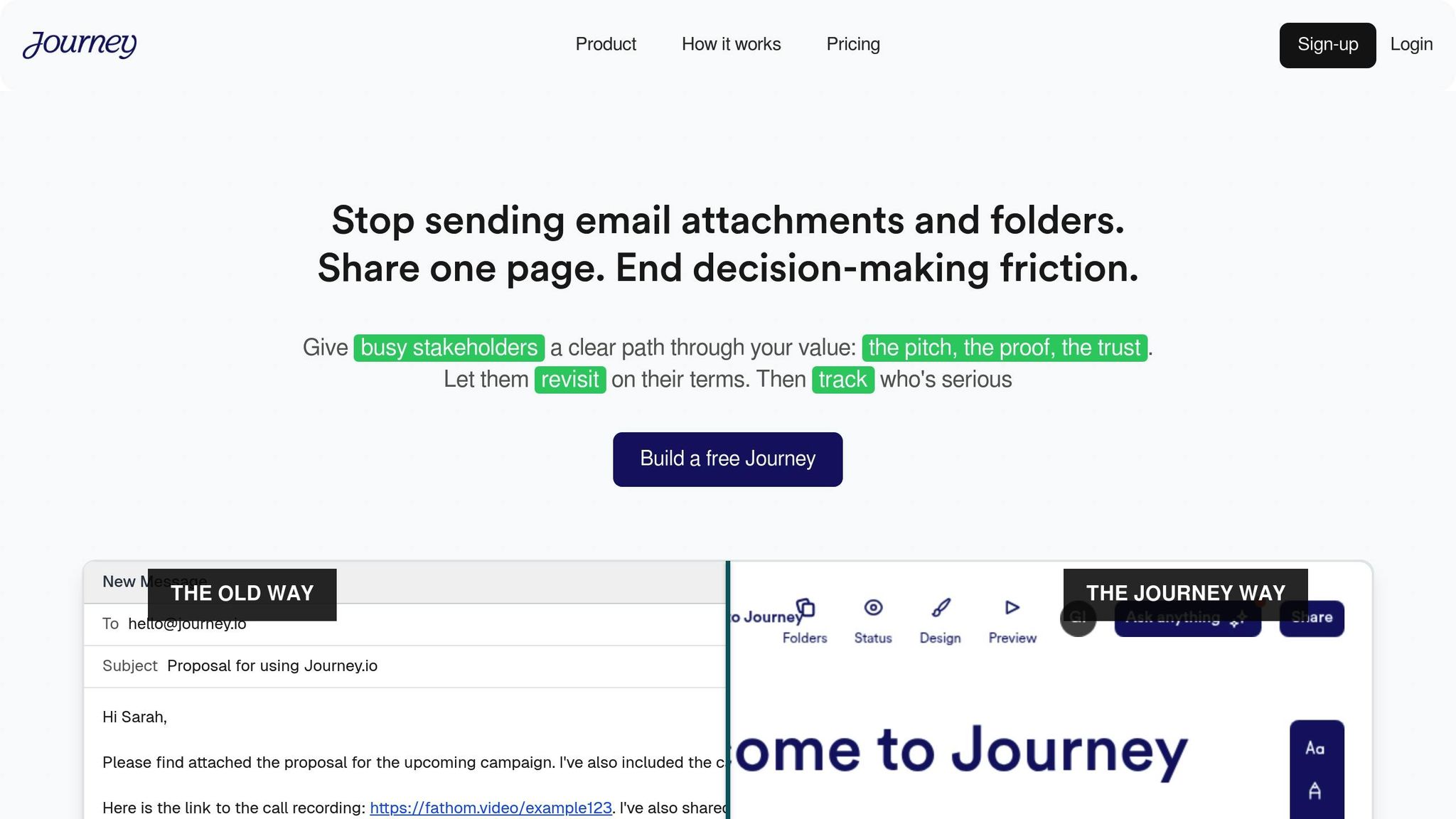
Journey.io simplifies the chaos of scattered resources by pulling together materials from emails, drives, and other platforms into one centralized, shareable link. This ensures that everything stays organized and accessible, preserving context along the way. Whether it's PDFs, videos, text, or AI-generated visuals, the platform accommodates multiple formats. Plus, with the ability to generate in-app flows from simple text prompts, businesses can quickly update and tailor onboarding content without needing technical expertise.
This approach tackles a major issue: roughly 60%-70% of B2B content goes unused. By making relevant materials easy to find and act on, Journey.io ensures that onboarding resources remain practical and impactful. The platform also leverages modern AI to create interactive demos, complete with AI voice narration. With natural language prompts, businesses can seamlessly align marketing goals with personalized customer journeys.
And it doesn’t stop there - real-time analytics provide an extra layer of insight to refine and improve the onboarding process.
Real-Time Engagement Insights
Journey.io brings clarity to the onboarding process through real-time analytics. Instead of relying on guesswork, businesses can now track exactly how users interact with content. The platform identifies pain points, such as confusing instructions, overly complex setup steps, or features that users abandon entirely.
These analytics highlight critical "at-risk" signals - like repeated errors, skipped steps, or long periods of inactivity - allowing teams to step in proactively before users lose interest. On the flip side, the data also reveals the "aha moments", those key actions that signal successful user activation. By understanding these moments, businesses can fine-tune their onboarding flows to guide more users toward these milestones.
With 75% of B2B buyers preferring self-guided research, this visibility into user behavior is crucial for creating onboarding experiences that truly resonate. Journey.io helps businesses meet users where they are, delivering personalized, effective journeys that keep them engaged.
I Built an AI System that Onboards Clients in 30 Seconds (Free n8n Template)
Conclusion
AI-powered onboarding is transforming how businesses engage and retain users. The data speaks volumes: companies using AI-driven onboarding experience a 200% increase in completion rates, while Time-to-First-Value shrinks by 75%, reducing timelines from weeks to just 3–5 days.
The move from generic product tours to tailored experiences is a game-changer. AI doesn’t just segment users; it adapts to each individual in real-time. It identifies friction points before they cause drop-offs and even predicts when a user might disengage. The payoff? 30-day retention rates climb by 85%, while support tickets see a 40% reduction.
For product teams, this is a major shift. Instead of being bogged down with creating manual tours or answering repetitive questions, AI takes over the operational tasks. Chatbots handle FAQs, predictive analytics highlight users at risk of churning, and onboarding guidance adjusts dynamically based on user behavior. This frees teams to focus on big-picture strategies rather than day-to-day execution.
Journey.io plays a critical role here by addressing a common problem: scattered onboarding content. When materials are spread across emails, drives, and platforms, even the smartest AI can’t deliver seamless guidance. Journey.io centralizes everything into shareable, trackable links with real-time analytics, ensuring that personalized onboarding actually works. Users get exactly what they need, when they need it - eliminating the friction that derails engagement.
This streamlined approach lays the groundwork for future advancements in onboarding. The momentum is undeniable. By 2025, 25% of organizations are expected to incorporate generative AI into their onboarding programs. The real question is: how soon can you get started with AI-driven onboarding?
FAQs
How does AI create personalized onboarding experiences for different roles?
AI transforms onboarding by creating a tailored experience that aligns with each user’s role, skills, and preferences. It adjusts communication, simplifies workflows, and delivers role-specific resources, ensuring users get the exact guidance they need.
For instance, AI can personalize training materials, handle repetitive tasks automatically, and offer real-time support based on individual requirements. This kind of customization not only keeps users engaged but also shortens the time it takes for them to get up to speed.
By making onboarding more seamless and relevant, AI helps organizations provide a smoother, more supportive introduction for new hires or users, setting the stage for long-term success right from day one.
How do AI chatbots help speed up the onboarding process?
AI chatbots make the onboarding process faster and smoother by delivering instant, tailored support. They can guide users based on their specific roles, address common questions, and assist with navigating systems, helping new users get up to speed more quickly.
By automating routine tasks and offering help whenever needed, AI chatbots cut down on manual follow-ups. This means businesses can expand their onboarding efforts without sacrificing quality. The result? A streamlined experience that reduces learning time and boosts user satisfaction.
How does predictive analytics help keep users engaged during onboarding?
Predictive analytics plays a key role in keeping users engaged during onboarding by leveraging data to craft personalized and adaptive experiences. By analyzing user behavior, it can identify early signs of frustration or disengagement. This allows businesses to intervene at the right moment with helpful solutions, such as customized tutorials or step-by-step guidance. These timely actions help users stay on track and significantly lower the chances of them dropping out.
On top of that, predictive analytics can adjust onboarding paths in real time based on how users interact with the platform. This ensures that each person gets content and support tailored to their needs, exactly when they need it. By making the process more intuitive and focused on the user, businesses can increase satisfaction, improve completion rates, and establish stronger connections right from the start.
Related Posts