
Real-Time User Insights: Benefits for B2B Companies
Real-Time User Insights: Benefits for B2B Companies
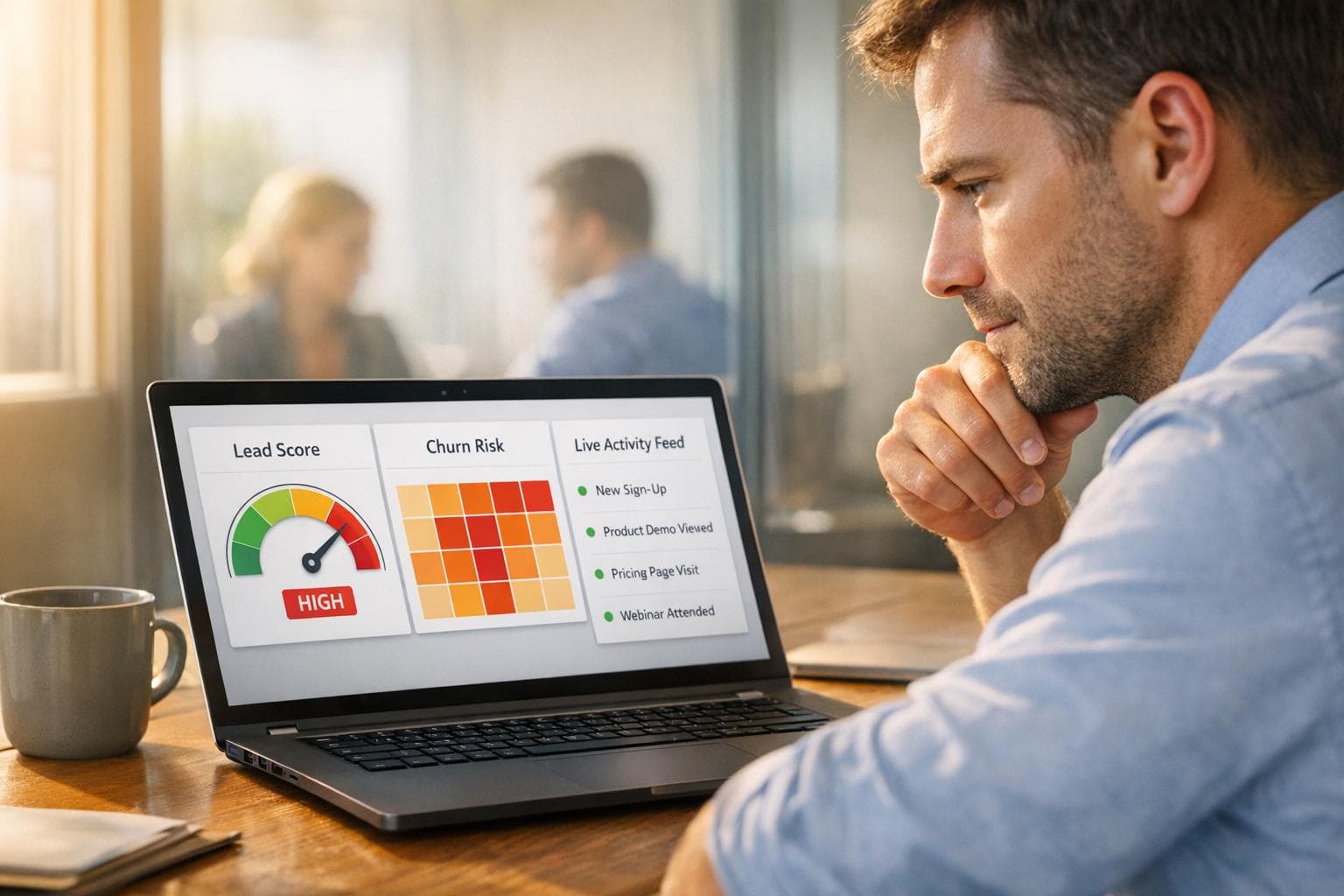
Real-time user insights are transforming how B2B companies operate by enabling faster, data-driven decisions that improve customer engagement, boost conversions, and reduce churn. Unlike traditional batch analytics, real-time data processing happens in seconds, offering immediate insights that allow teams to act quickly and effectively.
Key Takeaways:
- Faster Decision-Making: Real-time data helps businesses respond instantly to customer behavior, avoiding delays caused by outdated analytics.
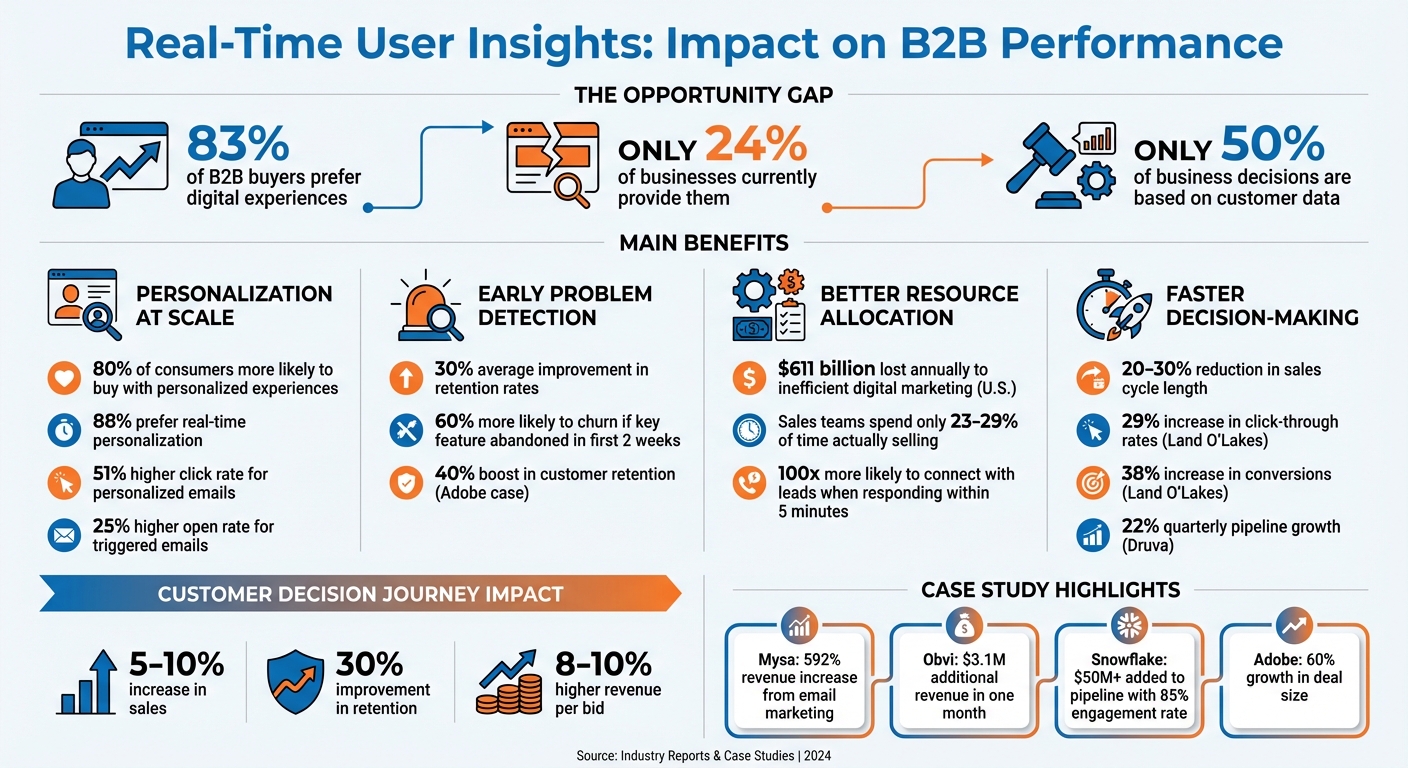
- Improved Personalization: Tailored experiences based on live customer actions lead to higher engagement and conversion rates - e.g., personalized emails see a 51% higher click rate.
- Early Problem Detection: Teams can identify and resolve issues, like churn risks or low engagement, before they escalate.
- Better Resource Management: Focus efforts on high-intent leads, optimize ad spend, and prioritize actions that drive the most impact.
For example, Land O'Lakes saw a 29% increase in click-through rates and a 38% rise in conversions after adopting a real-time Customer Data Platform. Similarly, Druva and Obvi leveraged real-time insights to grow pipelines and revenue while addressing friction points in their customer journeys.
Real-time insights aren't just about speed - they're about using live data to deliver more relevant, timely, and effective strategies across sales, marketing, and customer success teams. With only 50% of business decisions currently based on customer data, adopting real-time analytics presents a major opportunity for growth.
Real-Time User Insights ROI: Key Statistics and Benefits for B2B Companies
Benefits of Real-Time User Insights
Personalization at Scale
Real-time insights let businesses deliver tailored experiences to a large audience, all without manual effort. Here’s why this matters: 80% of people are more likely to buy from companies offering personalized experiences, and 88% of consumers are more likely to purchase when personalization happens in real time.
With real-time data, customers can be segmented instantly based on their lifecycle stage - whether they’re in the awareness, conversion, or retention phase. For instance, if a prospect downloads a pricing guide, checks out case studies, or watches a demo video, systems can immediately adjust messaging across email, SMS, push notifications, and in-app channels to fit that exact moment.
Take Mysa, a smart thermostat company, as an example. By using real-time personalization throughout the customer journey, they saw a 592% revenue increase from email marketing alone. This aligns with industry findings: personalized triggered emails achieve a 25% higher open rate and a 51% higher click rate compared to generic campaigns.
For B2B companies, where buying decisions often involve multiple stakeholders, real-time Customer Data Platforms (CDPs) play a critical role. These platforms consolidate various identifiers - like IP addresses, anonymous visitors, and roles within buying committees - into a single profile. This enables sales teams to respond to active buying signals and adjust their messaging to address specific challenges at the account level.
But this isn’t just about personalization. Real-time insights also help teams identify problems before they escalate.
Identifying and Solving Problems Early
Beyond improving engagement, real-time tracking helps businesses tackle issues before they lead to lost deals or customer churn. By monitoring behavior as it happens, companies can take action while interest is still high.
For example, Druva, a data protection company, used real-time signals to track webinar and demo requests as they occurred. Antony Arcan, EMEA SDR Manager, leveraged this data to achieve a 22% quarterly pipeline growth and record-breaking marketing-sourced revenue during the 2024–2025 period. The secret? Acting on signals while prospects were still engaged rather than waiting for interest to wane.
Real-time tracking also highlights specific friction points in the customer journey. In 2025, health supplement company Obvi noticed that a call-to-action button was placed too low on mobile pages, thanks to revenue-per-session data. Adjusting the button’s placement resulted in an additional $3.1 million in revenue in just one month.
For customer success teams, real-time alerts can flag warning signs like reduced session frequency, feature abandonment, or when a key decision-maker stops engaging. These signals help teams address potential churn risks before they become formal complaints. Adopting a Customer Decision Journey (CDJ) approach to monitor these patterns can improve retention rates by an average of 30%.
"With real-time data, you can detect and address changes in customer needs before they impact satisfaction or revenue." – Contentstack Team
This proactive approach doesn’t just prevent problems - it also ensures resources are used more effectively.
Better Resource Allocation
Real-time insights allow teams to focus their efforts where they’ll have the greatest impact. Poor resource allocation is costly - inefficient digital marketing campaigns alone result in $611 billion in annual losses in the U.S.. Real-time data eliminates this waste by identifying which channels, campaigns, and accounts deserve attention right now, rather than relying on outdated metrics.
For instance, NFON UK, a cloud telephony provider, used real-time intent data to identify 400 high-intent resellers in just six months. By focusing outreach on those actively engaging with content, the sales team signed eight new partners projected to generate significant revenue. This highlights a key principle: knowing who’s engaging with your content helps streamline both time and costs.
Sales teams, who currently spend only 23% to 29% of their time selling, benefit from real-time platforms that automate data collection and analysis. This frees them from administrative tasks, while marketing teams can dynamically adjust ad budgets to match audience behavior. Meanwhile, customer success teams receive instant alerts for high-risk accounts, enabling early intervention before renewal deadlines.
Here’s how real-time insights improve resource allocation across departments:
| Department | Real-Time Use Case | Expected Resource Benefit |
|---|---|---|
| Marketing | Ad spend adjustment | Reduced wasted spend on low-intent audiences |
| Sales | Intelligent lead routing | Senior reps focus on high-scoring, "hot" leads |
| Customer Success | Sentiment-based alerts | Proactive intervention on high-value renewals |
| Product | Feature usage monitoring | Prioritized roadmap based on live adoption data |
| Support | Proactive issue detection | Reduced ticket volume through early resolutions |
sbb-itb-e400484
How customer data platforms can provide real time insights to drive growth
Case Studies: Real-Time Insights in Action
These examples highlight how using real-time insights can lead to measurable business improvements.
Case Study 1: Boosting Engagement with Real-Time Personalization
In May 2025, Land O'Lakes adopted Contentstack's real-time Customer Data Platform to centralize customer data and create tailored digital experiences. Steve Rude, a key figure in the project, underscored the value of focusing on precision rather than sheer volume in marketing:
"Impressions are the metric of a failed marketing campaign… If you're not getting the conversions, it means you weren't hitting the right audience." - Steve Rude, Land O'Lakes
By harnessing real-time data, Land O'Lakes achieved a 29% increase in click-through rates and a 38% jump in conversions. This shift allowed them to move away from one-size-fits-all campaigns and deliver content that matched individual customer needs as they arose.
Case Study 2: Expanding the Sales Pipeline with Behavioral Tracking
In July 2025, Snowflake rolled out a highly targeted ABM (Account-Based Marketing) program aimed at 200 major accounts. The strategy combined premium direct mail - such as tablets and booklets sent to decision-makers - with real-time tracking through unique URLs embedded in each package.
This approach enabled Snowflake to monitor executive engagement and identify topics of interest. The results? An impressive 85% package open rate and over $50 million added to their sales pipeline.
Case Study 3: Preventing Churn with Proactive Alerts
Adobe implemented a data-driven ABM strategy targeting Fortune 500 accounts, crafting real-time content journeys for each target. For instance, when an executive viewed specific retail analytics content, Adobe's system adjusted future interactions accordingly.
This real-time responsiveness allowed customer success teams to act before churn became evident. The outcome was a 60% growth in average deal size and a 40% boost in customer retention.
These examples illustrate how real-time insights can reshape B2B strategies, delivering tangible results across various business functions.
How Real-Time Insights Change B2B Functions
Real-time insights are shaking up how B2B teams work every day. Instead of waiting for weekly reports or monthly dashboards, sales, marketing, and customer success teams can now act on customer signals as they happen. This shift from reacting after the fact to responding in the moment is driving measurable improvements across the board. Let’s dive into how these insights are transforming specific functions.
Sales: Focusing on High-Intent Leads
Sales teams often waste time chasing leads that aren’t ready to make a decision. But with real-time tracking, they can instantly identify buying intent. For example, when a prospect visits a pricing page or downloads a whitepaper, sales reps receive immediate alerts, allowing them to engage while the interest is fresh. Real-time engagement scoring helps teams prioritize leads based on live activity, leading to higher conversion rates. By integrating CRM systems with real-time web, app, and customer service data, companies can create unified customer profiles. These profiles, combined with event triggers, enable personalized interactions - something that makes 80% of people more likely to make a purchase.
Marketing: Trigger-Based Campaigns
For marketing teams, real-time insights open the door to trigger-based campaigns that feel more personal and timely. Instead of relying on static audience segments or past behaviors, marketers can use dynamic segmentation to engage customers based on their current actions. This approach helps move customers through the lifecycle stages - awareness, consideration, and decision - more effectively. Companies using real-time customer data platforms have seen a 29% boost in click-through rates and a 38% jump in conversion rates. Triggered emails, in particular, deliver impressive results, with 25% higher open rates and 51% higher click rates. By connecting customer data platforms with marketing automation tools, marketers can launch campaigns instantly and shift budgets toward leads that show high intent.
Customer Success: Improving Retention with Usage Analytics
For customer success teams, real-time usage analytics are a game-changer. Instead of finding out about issues after they’ve escalated, teams can now spot churn risks as soon as they arise. For instance, a drop in logins or reduced engagement can trigger immediate alerts, giving teams the chance to step in before problems grow. Research shows that users who stop using a key feature within their first two weeks are 60% more likely to churn by the second month. Companies using real-time analytics report an average 30% increase in customer retention, with half of them also seeing boosts in customer loyalty. AI-powered sentiment analysis adds another layer of insight by detecting shifts in user sentiment from emails, video calls, or messages, enabling proactive support that keeps satisfaction high.
This shift to real-time, proactive strategies is reshaping how B2B teams operate. Tools like Journey.io give sales, marketing, and customer success teams the ability to act on immediate customer signals, solidifying the move toward data-driven engagement.
Measuring ROI from Real-Time User Insights
Metrics to Track
Once you've tapped into the benefits of real-time insights, the next step is measuring their impact. Start with Customer Lifetime Value (CLV) to assess the revenue each customer generates over time, and pair that with Customer Acquisition Cost (CAC) to see how much you're spending to bring them in. The ideal scenario? Lower CAC and higher CLV - this shows that real-time insights are helping you attract the right customers and retain them longer. Another key metric is pipeline velocity, which tracks how fast deals progress through your sales funnel. Implementing real-time insights can cut your sales cycle by 20–30%. Keep an eye on conversion rates, Net Promoter Score (NPS), and churn rate as well. These metrics reveal how well real-time insights are fine-tuning your strategies, with about 50% of organizations reporting better customer retention and loyalty through real-time analytics.
Operational metrics also play a big role. Track resolution rate and response time to measure how quickly your team acts on real-time signals. For instance, sales teams are 100 times more likely to connect with a lead if they respond within five minutes of receiving a signal. Another valuable metric is time-to-value, which shows how quickly customers experience results - this directly affects retention. AI-powered customer support can automate up to 65% of tasks and handle 70% of customer interactions, allowing your team to focus on higher-value tasks.
ROI Case Study Table
Here’s a snapshot of how real-world companies have measured ROI from real-time insights:
| Company | Initiative | Timeframe | Key Metric | Result |
|---|---|---|---|---|
| Land O'Lakes | Real-time CDP integration for personalized experiences | May 2025 | Click-through rate (CTR) | 29% increase |
| Land O'Lakes | Real-time personalization across customer touchpoints | May 2025 | Conversion rate | 38% increase |
| Industry Dive | Real-time data integration to track customer journeys | May 2025 | Customer engagement | 40% increase |
| Mysa | Real-time personalization throughout the customer lifecycle | 2024 | Email marketing revenue | 592% increase |
Tips for Driving ROI
To maximize ROI, focus on metrics like win rate, CAC, and pipeline velocity. Use real-time alerts to flag issues such as at-risk deals, negative sentiment, or stalled communication, so your team can act immediately.
Collaboration is key. Align your sales, marketing, and customer success teams around shared goals. When everyone works from the same playbook, insights are turned into action seamlessly. Standardize definitions for terms like "MQL" (Marketing Qualified Lead) or "Win Rate" across departments to ensure consistency and maintain a unified source of truth. Also, calculate CAC payback - the time it takes to recover acquisition costs - to gauge whether your real-time marketing efforts are cost-effective. Companies that adopt a Customer Decision Journey approach often see a 5–10% boost in sales, a 30% improvement in retention, and 8–10% higher revenue per bid compared to traditional methods.
Conclusion
Real-time user insights are reshaping how B2B companies operate, especially when only 24% of businesses currently provide the digital experiences preferred by a staggering 83% of buyers. This disconnect presents a major opportunity for companies ready to move beyond outdated, historical reporting and embrace proactive, real-time decision-making.
The numbers speak volumes: real-time data can lead to a 38% increase in conversions while also driving retention, loyalty, and revenue. Yet, only about half of business decisions today are informed by customer insight data. This leaves a significant amount of potential untapped for most B2B organizations.
The advantages of real-time insights ripple across all departments. Sales teams can zero in on high-intent leads as they emerge. Marketing can launch tailored campaigns based on actual user behavior rather than guesses. Customer success teams can spot churn risks early, addressing issues before relationships falter. As Gainsight puts it:
"In 2025, real-time insights will be foundational to any revenue strategy focused on retention, growth, and operational efficiency".
Acting on real-time insights gives companies a clear competitive edge. With buyers spending 27% of their time researching independently online and just 17% engaging directly with suppliers, delivering timely, relevant content is what sets leaders apart. These insights aren't just about improving processes - they enable the flexibility and responsiveness needed to meet the demands of today's digital-first B2B buyers. That kind of agility is what separates those who thrive from those who fall behind.
FAQs
How can real-time user insights enhance customer engagement for B2B companies?
Real-time user insights give B2B companies the ability to craft more personalized and engaging customer experiences. By analyzing user behavior as it unfolds, businesses can quickly address problems, customize interactions to meet specific needs, and deliver content that truly connects with their audience.
This real-time approach strengthens trust, enhances customer satisfaction, and builds deeper relationships. It also equips teams with the tools to make informed decisions, fine-tune marketing strategies, and increase conversion rates, leading to stronger overall business performance.
How do real-time insights help reduce customer churn?
Real-time insights give businesses the ability to spot and tackle potential problems early, keeping customers on board. By tracking user behavior and engagement in the moment, companies can step in quickly when they notice warning signs like reduced activity or slower response times.
This kind of data also opens the door for personalized interactions, showing customers that they’re genuinely valued. Addressing their concerns in a way that feels tailored to them not only fixes issues on the spot but also builds trust and strengthens relationships, making it less likely they’ll walk away.
How does real-time data improve personalized marketing strategies?
Real-time data empowers businesses to craft highly personalized marketing experiences by reacting immediately to customer actions and preferences. This ensures that the content delivered is not just relevant but also perfectly timed, leading to stronger engagement and improved conversion rates.
By monitoring user behavior as it unfolds, companies can adjust their messaging and offers on the fly, making every interaction feel uniquely tailored. This level of customization fosters trust and elevates the customer experience - something particularly important in the world of B2B relationships.
Related Posts