
Ultimate Guide to Customer Engagement Metrics 2025

Ultimate Guide to Customer Engagement Metrics 2025
In 2025, tracking customer engagement metrics is essential for businesses to grow and retain customers. These metrics reveal how users interact with your content, products, and services, helping you make smarter decisions and improve customer satisfaction. Here’s a quick summary of the key points:
-
Top Metrics to Track:
- Conversion Rates: Measure actions like purchases or email signups.
- Customer Lifetime Value (CLV): Understand long-term customer contributions.
- Net Promoter Score (NPS): Gauge customer loyalty and satisfaction.
- Content Performance: Analyze view time, completion rates, and engagement.
-
Key Strategies:
- Segment Customers: Group users by behavior, engagement, or value.
- Predict Future Behavior: Use analytics to spot trends and prevent churn.
- Multi-Channel Data: Combine insights from email, social media, and direct communication.
-
Tools to Use:
- Platforms like Journey.io simplify tracking, real-time monitoring, and content optimization.
Understanding Customer Engagement Metrics
Core Concepts
Customer engagement metrics measure how users interact with your business across various touchpoints. These metrics track actions like clicks, downloads, viewing time, and scroll depth, offering insights into user preferences, decision-making, and support needs.
Modern tools combine data such as download rates, time spent on content, shares, follow-up actions, and cross-channel activity. Together, this data provides a complete picture of how customers engage with your brand.
Business Impact
Using engagement metrics effectively can lead to better business outcomes:
- Revenue Growth: Identify buying signals, address customer needs, and improve conversion rates by analyzing interactions.
- Content Improvements: See which resources perform well with different audiences and adjust or create content based on those insights.
- Customer Satisfaction: Spot trends in engagement to gauge satisfaction levels and address potential problems early.
These metrics help guide decisions on resource use, content strategies, and support efforts, ensuring every customer interaction drives your business forward.
Customer Metrics: NPS, CLV & More
Essential Metrics for 2025
In 2025, keeping an eye on the right customer engagement metrics will be key to staying competitive. Here’s a breakdown of the metrics that matter most:
Conversion Rates
Conversion rates show the percentage of users taking specific actions, like downloading content or making a purchase. Break these rates down by:
- Channel: Which platforms drive the best conversions?
- Content: How do formats like videos or PDFs perform?
- Customer Segments: How do different groups respond?
Don’t just focus on big wins like purchases (macro-conversions). Pay attention to smaller actions, like email signups (micro-conversions), to get a full view of your funnel’s performance. Once you’ve got that, dive into Customer Lifetime Value to understand your most loyal customers.
Customer Lifetime Value
Customer Lifetime Value (CLV) shows how much a customer contributes to your business over time. Calculate it by multiplying:
- Average purchase value
- Purchase frequency
- Customer lifespan
For B2B companies, include factors like contract renewals, upsells, and referrals. Check CLV trends every quarter to spot changes in behavior and adjust your strategy. Next up, measure satisfaction with the Net Promoter Score.
Net Promoter Score
Net Promoter Score (NPS) measures how satisfied and loyal your customers are. Focus on:
- Asking customers at important touchpoints
- Watching how NPS changes over time
- Breaking down scores by customer type
The key question? "On a scale of 0-10, how likely are you to recommend our service?"
Content Performance
Content performance metrics help you understand how users interact with your materials. Keep an eye on:
- View time
- Completion rates
- Engagement levels
This data helps you fine-tune your content strategy by showing what works and when customers might need extra support. Regularly analyzing this info ensures your content stays effective.
sbb-itb-e400484
Data Analysis Methods
Modern engagement analysis transforms raw data into insights you can act on.
Customer Segmentation
Breaking your audience into smaller groups allows for more tailored experiences. Here are some ways to segment effectively:
- Behavioral patterns: Observe how users interact with your content.
- Engagement levels: Categorize users based on how often and deeply they engage.
- Value tiers: Use spending habits and lifetime value to create groups.
For even better results, combine criteria like engagement frequency with content preferences. Tools like Journey.io make it easier to track user interactions and identify distinct groups. By monitoring how these segments respond to different content, you can fine-tune your approach.
The next step? Predict what your customers will do next.
Future Behavior Analysis
Predictive analytics goes beyond grouping users - it helps you foresee their needs and reduce churn. Key areas to watch include:
- Engagement frequency changes: Sudden drops or spikes can signal shifting interests.
- Content consumption patterns: Which types of content are gaining or losing traction?
- Response rates: How users react to various formats and campaigns.
If engagement starts to dip, quickly deploy content that resonated in the past. Journey.io’s real-time analytics can highlight these shifts as they occur, enabling a fast and effective response.
Multi-Channel Data
To truly understand your customers, you need to combine data from all touchpoints. Here’s how to approach it:
Data Integration Strategy
| Channel Type | Key Metrics | Integration Priority |
|---|---|---|
| Content Interactions | View time, completion rates | High |
| Email Engagement | Open rates, click-through rates | Medium |
| Social Activity | Shares, comments | Medium |
| Direct Communication | Response times, frequency | High |
Improving Engagement Scores
Content Updates
Revamp your content to address every step of the customer journey. Start by auditing your existing materials to find gaps and areas for improvement.
Use Journey.io's packaging tools to simplify how content is accessed and shared. These tools combine PDFs, videos, and interactive elements into trackable links, making it easier for users to engage with your materials.
Here are some key areas to focus on:
- Keep Content Current: Regularly review and update materials to ensure they remain relevant.
- Offer Varied Formats: Use a mix of content types to appeal to different learning styles.
- Make It Accessible: Ensure content is easy to find and share.
- Track Performance: Use engagement metrics to see what content resonates most with your audience.
Lastly, improve how you gather and act on feedback to further enhance engagement.
User Feedback Systems
Set up multiple ways to gather feedback from your audience.
Feedback Collection Framework
| Method | Purpose | Response Time |
|---|---|---|
| In-content Comments | Capture immediate reactions | Less than 24 hours |
| Satisfaction Surveys | Gather detailed user insights | 48-72 hours |
| Direct Communication | Resolve complex issues quickly | Same business day |
| Usage Analytics | Spot behavioral trends | Real-time |
Monitor how prospects interact with your content to identify any friction points. This data will help you decide which areas need the most attention.
Customer Retention
Strengthen customer relationships with consistent support and timely communication. Use insights from real-time analytics to create a tailored retention plan that complements your engagement strategy.
Focus on these retention drivers:
- Personalized Content: Customize materials and interactions for different customer segments.
- Comprehensive Support: Provide clear documentation and helpful resources.
- Track Success: Monitor customer progress and celebrate their milestones.
- Automated Engagement: Set up automated responses triggered by user behavior.
If you notice early signs of disengagement, act quickly with targeted retention efforts. Combine these efforts with your content distribution strategy to maximize impact. Journey.io's tracking tools can help you pinpoint which materials keep users engaged, so you can replicate successful strategies across your audience.
Journey.io Features and Tools
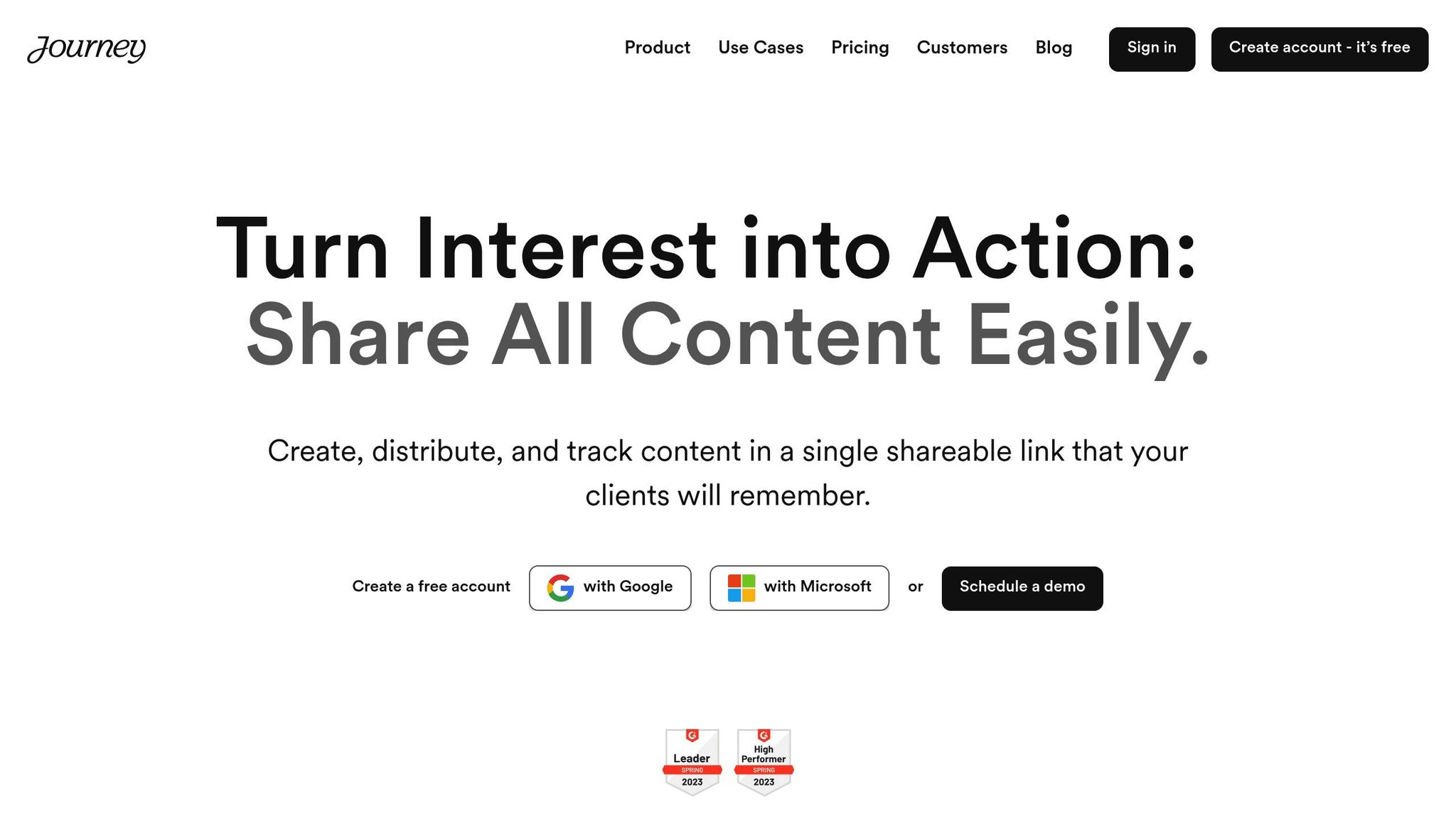
Content Tools
Journey.io helps you create engaging, trackable content by combining various formats into a single, shareable link. This makes distribution easier and more effective.
Here are some standout features:
- AI-assisted text creation for consistent messaging
- Interactive tools like chatbots and comments
- Rich media options including videos, PDFs, and AI-generated visuals
To boost interaction, Journey.io uses content blocks like these:
| Content Type | Purpose | Engagement Feature |
|---|---|---|
| Video Recording | Personal communication | Direct viewer feedback |
| Collaborative Plans | Project coordination | Interactive checklists |
| AI Images | Visual engagement | Custom illustrations |
| Interactive Navigation | Content organization | Quick access points |
On top of these features, Journey.io includes real-time tracking to monitor how users engage with your content.
Live Tracking
Journey.io provides real-time insights, allowing you to respond quickly to user activity. It tracks:
- How long content is viewed
- Usage of interactive elements
- Document download trends
- Comment participation levels
This tracking pairs seamlessly with data integration tools for deeper analysis.
Data Integration
Journey.io simplifies data-driven decisions with tools like:
- Clearbit Integration for enriched customer data
- Activity Notifications to stay updated
- Custom Analytics for tailored insights
- Secure Sharing through password protection and IP whitelisting
These features work together to create an efficient system for improving customer engagement.
Conclusion
By 2025, customer engagement metrics are shaping data-driven business success. When used effectively, these metrics help companies build stronger relationships with their customers and drive growth.
Three main areas are crucial for improving customer engagement:
Real-Time Monitoring and Response
Live tracking allows businesses to provide quick, personalized support. Tools like Journey.io offer real-time insights, helping teams spot engagement patterns and respond promptly, boosting customer satisfaction and loyalty.
Content Optimization
Delivering optimized content through shareable links enhances the customer experience. Journey.io's tracking features let teams refine their strategies based on actual user engagement data, making improvements where it matters most.
Data-Driven Decision Making
Integrating engagement metrics across multiple channels gives businesses a clearer view of the customer journey. This approach enables targeted actions in several areas:
| Focus Area | Benefit |
|---|---|
| Customer Retention | Spot early risks through engagement data |
| Content Strategy | Allocate resources more effectively |
| Support Experience | Deliver timely, precise assistance |
| Revenue Growth | Expand in high-engagement areas |
By tracking, analyzing, and acting on engagement data, businesses can set themselves apart. Using platforms that provide detailed insights into customer behavior, companies can create more profitable and lasting customer connections.
Turning raw data into actionable insights is a game-changer for growth. Engagement metrics are no longer just numbers - they’re the foundation for meaningful interactions that drive success.
Related Posts